

Tuko Pamoja: We are Together
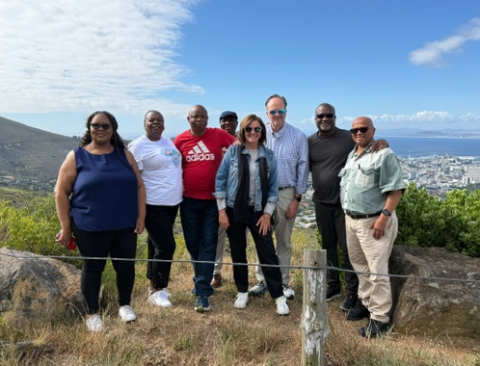
This was Debbie’s and my first year in jurisdiction on the Africa Region. Our three, month-long tours (November, January, and March) were filled with assemblies, ordination services, leadership meetings, and many church services. We visited 7 different countries and ordained 175 new ministers. The Spirit of God is moving through the Church of the Nazarene in Africa, and it was a joy to get to witness it. This year the number of Nazarenes in Africa passed 1 million, making it the first region in the denomination to achieve that goal.
The regional theme for this quadrennium is tuko Pamoja, meaning “we are together”. Although there is an incredible diversity of cultures and languages on the African continent, there is also an amazing spirit of unity and partnership between the 44 countries, 7 missional fields, 145 districts, and almost 9,000 churches on the region. We may come from different places and speak different languages, but we share the same Spirit.
Our October/November tour was confined to South Africa and was memorable for three meetings, a hot meal, and a birthday party.
One of our first stops was the beautiful city of Cape Town. On the evening before assembly, we had a relaxed dinner, an hour of open conversation, and a time of significant prayer with the pastors and spouses of the Western Cape district. The Lord met with us in such a significant way that we decided to set up several more of those kinds of meetings across the next tours.
In Johannesburg we got to sit in on the Regional Advisory Council (RAC) meetings. Although I got to open the Word for each of the meetings, the blessing for me was to hear about what God is doing through every area across the region. I am so thankful for the leadership of our regional director, Dr. Daniel Gomis, and his incredible team of field strategy coordinators, regional ministry leaders, and missionaries.
Also in Johannesburg, at Nazarene Theological College, we got to be part of training days for the district superintendents from the southern hub. Dr. Eddie Estep came from the U.S. to lead the training. He helped them capture a vision for the superintendent as “CMO”: the chief morale, motivation, management, and mission officer for the districts they lead.
The hot meal took place on one of the weekends. We had a district rally on a Sunday at the Chatsworth Church in Durban. The majority of the Chatsworth Church are of East Indian descent. They were very excited for us to try one of their local specialties called bunny chow. It is a half loaf of bread hollowed out in the center and filled with lamb curry. Those preparing the meal told us they made it milder than they normally do because they knew we would have sensitive American stomachs. Dany and I were committed to eating all that they gave us. Within a couple of bites, my hair was wet, and my lips went from on fire to numb. Dany kept having to wipe his head with a towel because of the sweat the spices were causing. It was delicious. I finished it, and it finished me.
Perhaps the highlight of the first tour was the ninetieth birthday party for the pioneer, preacher, and professor Dr. Enoch Litswele. Several hundred people gathered for a rousing celebration not only of his life but also of his significant influence on several generations of African leaders, including my colleague Dr. Fili Chambo.
Our January tour took us back to South Africa, then to Botswana and Cote d’Ivoire.
The month was filled with incredible assemblies, district rallies, and leadership seminars in Port Elizabeth (RSA), Cote d’Ivoire, and Rustenburg (RSA). It was a joy to get to know so many of our gifted pastors and leaders and reflect on the Lord’s call to “feed my sheep” (John 21:17).
On this tour we got to experience our first night safari in Kruger National Park. We got to see several animals, including the lions, on the move. But the highlight was when the driver stopped the truck and turned off the lights and engine. In the deep darkness we were surrounded by a million stars and all the sounds of the savannah.
In Botswana, a young boy in the church stole our hearts. His father was the drummer for the worship team, and he sat right next to his dad and played his air drums right along with him. Besides being incredibly cute, he became a symbol and reminder for Debbie and me of the huge number of young people in the African church. The median age of the African population is only nineteen, and the Church of the Nazarene has an incredible opportunity to raise up a generation of young disciples for Jesus on the continent.
The March tour took us to Kenya, Rwanda, Uganda, and Mozambique.
It took nine slaughtered goats to feed the Kenya Eastern district in Kitui, along with the forty ordinands and their families. For the first time in many years, the beautiful Lake Victoria district hosted an ordination service.
We had three special days of training for the district superintendents of the Eastern Field in the picturesque tea fields outside Nairobi. And I had the joy of visiting the special campus and meeting many of the students at Africa Nazarene University.
We spent three days with the leaders, both old and young, of the incredible churches of Mozambique. The church in Maputo hosted an ordination service attended by more than two thousand people with thirty-seven new ministers from the district being ordained.
In Uganda, I had the privilege of worshiping with one of our churches (led by missionary John Yual) made up of South Sudanese refugees. I counted close to three hundred children and teens who sang for us in the service and shared some of their stories. Through the work of the Church of the Nazarene, not only are many of the refugee families being cared for and educated, but when, by God’s grace, they are able to return to South Sudan, they will go home as witnesses of God’s transforming love.
In the beautiful country of Rwanda, I had the honor of ordaining a woman named Agnes. During the Rwandan genocide, six out of ten of her family members were killed. When the tragic killings were over, she began a small gathering in Kigali of survivors. That small group eventually became a church, and today Agnes serves as the co-pastor of the Kigali Church of the Nazarene (a congregation now of approximately five hundred members).
God is moving through the Church of the Nazarene in Africa. In the midst of so much diversity, there is great unity. Tuko Pamoja. We are in this together.
Scott Daniels is a general superintendent in the Church of the Nazarene.